


On the first moon walk, a flag was planted. Of the United States. Not of Earth — earth has no flag — only of the nation state, the USA. Aliens looking on must have been puzzled. Flags are bewildering things. I went to the USA in my late teens, and was astonished by all the flags. While there, I was reading, Bury My Heart at Wounded Knee by Dee Brown — about the slaughter of Native American Indians. Did the native American Indians have flags? I wondered. The America where I was staying had early morning ceremonies. As the Stars and Stripes fluttered, I remember lip-synching to what I thought was the USA anthem, America the Beautiful, America the Brave.
Flags have long been associated with conquest. The Briton, Robert Scott lost the race to the Antarctic pole but died with his flag which made him a hero in England. His body (and that of two of his companions) still lies buried under snow up there in Antarctica somewhere. I encountered the heroic Scott in my childhood from comics that featured his heroic deeds. Patriotism is powerful. I too wanted to be buried under snow with a flag by my side and write letters saying, I did it for England.
A couple of years later, I got into football and the England flag then meant for me the England team of the loping, graceful, Bobby Chorlton (I tried to adapt his comb-over), the cat-like goalkeeper, Gordon Banks, and the midfield enforcer, Nobby Stiles (there was nothing and no-one Nobby would not kick to get the ball).
Meanwhile, at the Evangelical Church I was attending in my broken-up shoes, the song we were often roused to sing by the Scottish Presbyterian Minister was “Send the boys to Vietnam, Hallelujah!” (quickly followed by “Send the girls to Vietnam, Hallelujah!”). Despite research, I have never figured out if this was a song made up by the Minister himself because he had a passion for the Vietnam War and saving the heathen Vietnamese, or whether it came from some official Scottish Presbyterian Church songbook. What the song did neatly was merge the idea of the religious crusade —crusades have always been great flag-waving occasions — with colonialism — the heathens need civilising — and patriotism: do it for England. We ten-year-old boys sang these lines with glee though with the wrong intent – please send the girls anywhere just get them away from us! And the girls replied with the same sentiment, vice versa. All good fun. Happy times. Except for the Vietnamese.
Jump forward forty years and, visiting my father in Umuahia, Nigeria, his friend told me he was known as ‘the English man.’ I asked why. The friend replied, ‘because he likes to grow roses and eats that Marmite spread they sell in England, and he has a bathtub in his house. A bathtub!’ I nodded. It made sense.
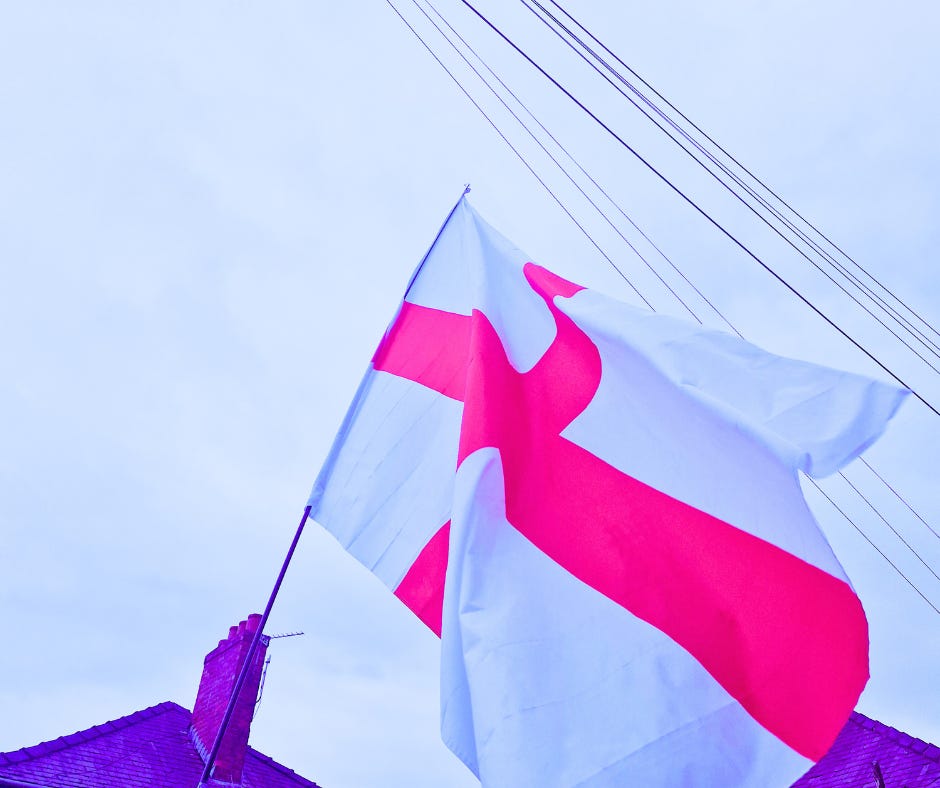
So, what is the St George flag that everyone is burning up about? It’s an empty vessel, and you can throw into it whatever you want. Chip butties. Yorkshire tea. Bobby Chorlton. Double-decker buses. Irrationality. Fervour. Whiteness. A way of shaking hands. A way of killing. And it’s an empty vessel that can make a huge amount of noise. It’s also a magician’s cloak. See these human beings struggling to survive? Watch. Pow! Now they’re vermin to be crushed, fleas to be squashed. Flags are patriotism made material. They combust easily. Their essential ambiguity is both cloak and shield for the rabble-rousers. Let us allow that quintessential Englishman, the 18th century diarist Samuel Johnson to play us out. “Patriotism is the last refuge of a scoundrel,” he reportedly said. We are living in an age of scoundrels.


